For many children, moving from one activity to another is simply part of the day. Breakfast ends and it is time to get dressed. Playtime ends and it is time to leave the house. The school day ends and the child goes home.
For some children with autism spectrum disorder (ASD), however, these seemingly ordinary transitions can be much more challenging.
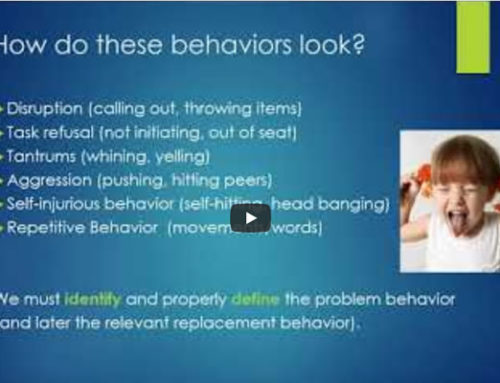
A child may become upset when asked to stop a favorite activity, resist getting ready for school, struggle when plans suddenly change, or become overwhelmed when entering an unfamiliar environment. These reactions are not necessarily about being defiant or unwilling to cooperate. The child may be having difficulty understanding what is happening, anticipating what comes next, communicating a concern, or adjusting to an unexpected change.
Understanding why transitions are difficult for a child with autism can help parents and caregivers develop strategies that make every day routines more manageable.
Why Can Transitions Be Difficult for Children with Autism?
Autism affects every child differently. Some children adapt to changes relatively easily, while others feel most comfortable when their environment and daily activities are predictable.
A transition introduces something new.
It may involve stopping an enjoyable activity, moving into a different physical environment, interacting with different people, processing new sensory information, or completing a task the child does not particularly enjoy.
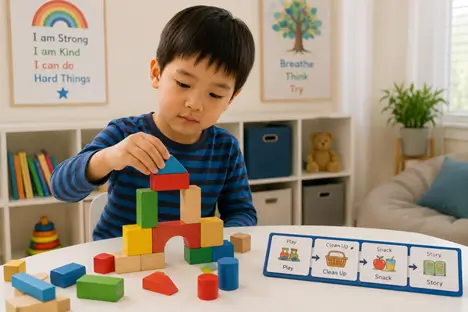
Imagine a child happily building a complicated structure with blocks. An adult suddenly says, “Okay, we’re leaving now.”
From the adult’s perspective, this is a normal instruction.
From the child’s perspective, an activity that felt comfortable and predictable has abruptly ended without enough time to understand or prepare for what is coming next.
The resulting frustration may appear as crying, refusing to move, arguing, dropping to the floor, running away, or other challenging behavior.
Instead of focusing only on the behavior itself, it can be helpful to ask:
What is making this transition difficult for this particular child?
The answer can help determine which strategies may be most useful.
Create Predictable Daily Routines
Predictability can make everyday life easier to understand.
A consistent morning routine, for example, might follow the same general sequence:
Wake up → use the bathroom → get dressed → eat breakfast → brush teeth → put on shoes → leave for school.
When children become familiar with the sequence, they may need fewer reminders because they begin to understand what happens next.
Consistency does not mean that every minute of every day must follow an inflexible schedule. Life changes and learning to cope with reasonable changes is an important skill.
Instead, routines can provide a familiar framework while children gradually learn how to manage variations within that framework.
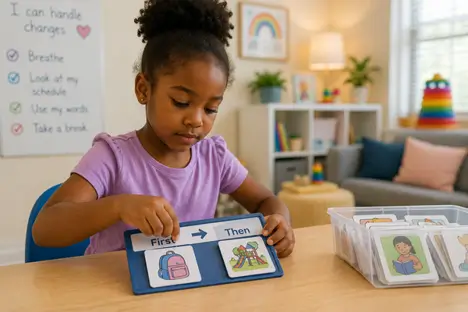
Use Visual Schedules

Some children understand information more easily when they can see what is going to happen rather than only hearing someone explain it.
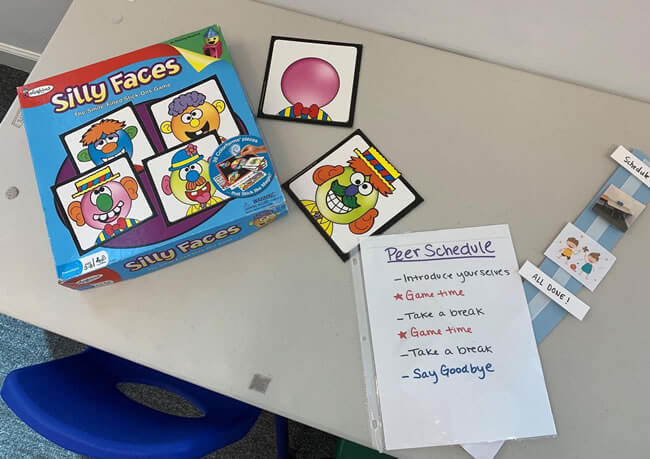
A visual schedule might use photographs, drawings, written words, symbols, or a combination depending on the child’s developmental and communication needs.
For example:
Breakfast → Get Dressed → School → Home → Snack → Play → Dinner → Bath → Bed
The schedule allows the child to look ahead and understand where they are in their day.
Parents can also remove or mark completed activities so the child can visually see progress through the schedule.
Visual support can be especially useful when preparing for activities that do not happen every day, such as a doctor’s appointment, haircut, birthday party, family gathering, or trip.
Give Advance Notice Before a Transition
Suddenly ending an activity can be difficult, particularly when a child is highly engaged in something they enjoy.
Advance warnings can make the transition less surprising.
A parent might say:
“Ten more minutes, then we are putting the tablet away.”
A few minutes later:
“Five more minutes.”
And finally:
“One more minute, then tablet time is finished.”
Timers can also be useful for some children because the timer—not the parent—provides a clear indication that the activity is ending.
The appropriate amount of warning depends on the individual child. Some children respond well to several reminders, while too many reminders may make another child more anxious.
Use “First, Then” Language
Simple language can make expectations easier to understand.
Instead of providing several instructions at once, try breaking the situation into two steps:
First shoes, then outside.
First homework, then computer.
First brush teeth, then story.
First clean up, then snack.
The goal is not simply to offer a reward. “First, then” language helps make the sequence of events clearer and reduces the amount of verbal information the child must process at one time.
Make Unexpected Changes More Understandable
Not every change can be planned.
A favorite restaurant may be closed. A teacher may be absent. School may be canceled because of weather. A doctor’s appointment may run late. A family outing may change because someone is sick.
These situations provide opportunities to gradually teach flexibility.
If you use a visual schedule, physically change the schedule and show the child what is different.
You might say:
“We planned to go to the playground, but it is raining. Playground is canceled. We are going to play inside instead.”
Keep explanations clear and concrete.
For some children, repeatedly discussing why something changed can create additional frustration. A short explanation followed by a clear description of the new plan may be easier to process.
Watch for Sensory Challenges During Transitions
Sometimes the transition itself is not the primary problem.
The destination may be difficult.
A child who refuses to enter a grocery store, for example, may be reacting to bright lights, crowds, unfamiliar smells, announcements over the speaker system, or the noise of shopping carts.
A child who resists getting ready for school may be anticipating a noisy bus ride or crowded hallway.
Understanding sensory preferences and sensitivities can change the way adults approach the behavior.
Instead of asking only, “Why won’t my child go?” consider asking, “What happens after we get there?”
Identifying environmental factors can help families and professionals develop more appropriate support.
Practice Important Transitions When Possible
Children do not have to learn every transition while the actual event is happening.
Practice can be valuable.
Before the first day at a new school, for example, a child may benefit from visiting the building, seeing the classroom, walking through the entrance, or looking at photographs of the teacher and school.
Before traveling, families might look at pictures of the airport, hotel, or destination.
Even everyday routines can be practiced when everyone is calm and there is less pressure.
Familiarity can reduce some of the uncertainty associated with a new experience.
Reinforce Successful Transitions
Notice when your child handles a transition successfully—even when it seems like a small accomplishment.
Praise should be specific whenever possible.
Instead of simply saying:
“Good job!”
You might say:
“You put your toys away when the timer went off. Nice job following the schedule.”
This helps the child understand exactly which behavior was successful.
Progress may occur gradually. A child who previously needed 20 minutes to transition away from an activity may eventually do it in 10 minutes, then five.
Those improvements matter.
When Challenging Behavior Happens, Look for the Reason
Challenging behavior communicates information.
When a child repeatedly struggles with a particular transition, look at what happens before, during, and after the behavior.
Ask questions such as:
- Does the behavior happen during certain activities?
- Does it occur more frequently when the child is tired or hungry?
- Is the child being asked to stop a highly preferred activity?
- Is the next environment loud, crowded, or uncomfortable?
- Does the child understand what is expected?
- Is the transition happening without sufficient warning?
- Is the child able to communicate that they need help or a break?
Patterns can provide important clues.
The goal is not simply to stop unwanted behavior. Understanding the function of behavior can help adults teach more effective communication, coping, and daily living skills.
Every Child With Autism Is Different
There is no single transition strategy that works for every autistic child.
One child may benefit greatly from visual schedules. Another may respond better to timers and verbal countdowns. Another may need sensory accommodations, additional communication support, or more opportunities to practice.
Strategies should be individualized according to the child’s strengths, developmental level, communication abilities, environment, and needs.
Parents also should not expect perfection. Learning to tolerate changes, wait, stop preferred activities, and move between environments involves skills that develop over time.
The goal is to progress without eliminating every difficult moment.
Supporting Children and Families
When transitions or challenging behaviors significantly interfere with a child’s daily activities, learning, family life, or participation in the community, professional support may help identify what is contributing to the difficulty.
At Behavioral Directions LLC, we recognize that behavior occurs for a reason. Understanding the individual child and the circumstances surrounding a behavior is an important part of developing meaningful strategies and support.
With consistency, appropriate support, and opportunities to practice new skills, children with autism can develop greater independence and become better prepared to navigate everyday changes.
Concerned about your child’s behavior, communication, routines, or ability to manage transitions? Contact Behavioral Directions LLC to learn more about behavioral assessment and individualized support for children and families.